

How To Apply Makeup So That It Doesnt Look Like You Have It On
For a person who wears makeup, the current mandate to wear a face mask in public tin can mean i of two things: Don't vesture makeup at all, or be prepared for makeup to move off your confront and onto your mask. But are those really the only options?
Not necessarily. Transfer-proofing techniques have been in professional makeup artists' armory for decades, and they've only gotten better with the advent of highly powerful sealants and fixing sprays, likewise as sophisticated formulas of long-wearing foundation. Merely if yous already have a foundation you like and are not inclined to buy a professional-grade fixing spray (some of which are almost $50 a canteen), you lot're in luck. A range of helpful techniques using products that you likely already take at domicile can help keep your makeup from transferring to your confront mask.
What follows is a trial run of five techniques ― by no means an exhaustive listing. For five days, I tried each of these techniques. I used the same pare care routine earlier each makeup application: I wore a clean black cloth face up mask from Los Angeles Dress for at to the lowest degree five hours each mean solar day during this menstruum, which happened to coincide with the outbreak of peaceful protests in New York City in solidarity with Black Lives Matter. I attended some of these protests while wearing full makeup and the mask.
Twenty-four hours 1: Jordan Liberty's Viral Skin Prep
The Technique
This technique, developed by makeup artist Jordan Freedom and popularized on TikTok, is all virtually creating an oil- and sweat-absorbing base of operations. Afterwards doing your skin intendance routine and applying moisturizer and sunscreen, you lot are supposed to dust translucent powder all over the confront. I recommend waiting nearly 15 minutes after yous've applied sunscreen to allow it settle into the skin, especially if you choose to apply a thicker variety with zinc or titanium dioxide. Next, utilise setting spray; allow it to dry. Then, employ a primer; I chose to use Milk Makeup's Hydrogrip Primer. Follow with your regular foundation, concealer and pulverization, and since you demand a setting spray to make this technique functional at all, do a concluding set with that, also.
The Result: Disappointing.

Niko Maragos
I found this technique kept my makeup looking good for more than than five hours of wear with a mask on. However, I think that the effect has more than to do with the amount of production that it requires you to apply to the peel: much of information technology can wear off throughout the mean solar day, merely enough is left behind that what you encounter in the mirror is still passably good. But when it comes to creating transferproof (or fifty-fifty transfer resistant) makeup, this technique was disappointing.
Day 2: Minimal Foundation And Powder Applied Through A Paper Towel
The Technique
A general piece of advice I've encountered as a makeup artist is that less product, strategically applied, makes for not merely a ameliorate result, merely a longer-wearing one. This is peculiarly true when there will exist friction between the pare and some other surface, a situation with which Sarah Cimino, a theatrical makeup designer, is quite familiar. She designed the makeup for the burlesque Company XIV'south Seven Sins, in which dozens of actors habiliment masks and face ornaments of all kinds through the show'due south seven acts.
"They don't wear a lot of foundation, and that'south for a couple of different reasons," Cimino said. "I do think that, especially wearing a mask daily, is going to present a lot of challenges to our makeup but also to our peel." To minimize that effect, Cimino encouraged a minimal amount of product set with a translucent pulverisation.
Following Cimino's advice, on Day 2 of my experiment I opted to use only concealer, rather than foundation, because I wanted a lilliputian chip more than coverage. With this particular formula, a water-resistant one, information technology wouldn't accept made sense to utilize a damp beauty blender. To avoid pulling up production with my fingers, I followed Jackie Aina'southward advice (repeated in many of her YouTube videos) to let the concealer sit for virtually 3 minutes. At that point, I blended it out with a flat, synthetic brush.
As an added layer of protection, I used an erstwhile lipstick trick from Cimino, with a slight twist. I took a paper towel, pulled the ply into its two thinner parts and held one slice over my face, pressing translucent pulverisation over the paper using a clean latex sponge.
The Result: Much better.

Niko Maragos
Far less product transferred to my mask this way, with most of the transfer occurring on the nose; with the previous method, there was product transfer around my chin. As there was less product on my skin, I likewise felt less made-up, and my pare felt less damp by the end of the mean solar day. But that'southward to be expected of a technique that does more with less. For the person who wants to wear more than production, who isn't comfy wearing just a bit of concealer, this technique is a nonstarter.
Day three: Hairspray
The Technique
I don't mean to retraumatize anyone with memories of their childhood dance recitals by bringing this technique up, just look: quondam tricks still work, kind of. For this technique, there is zip to be done differently from what you normally do, except to take a can of your favorite hairspray, close your optics and blast a few pumps on your face from nigh an arm's length away.
The Result: The worst so far.

Niko Maragos
This technique was slightly less effective than the previous day's technique, and this was without having been exterior that day for any reason. It's worth pointing out that my skin was as well the nigh uncomfortable by the end of the day. Given the discomfort and the relatively unremarkable payoff, without even subjecting it to the humidity and oestrus that day, I rank this technique lower than the others.
Twenty-four hour period 4: A Quick Broil
The Technique
"Baking" has taken on an outsize presence in the amateur dazzler earth in the past few years, and it'due south not without reason. The technique involves applying a hefty amount of loose powder over strategic areas of the face, letting information technology sit ("broil") for a catamenia of time (anywhere from a few seconds to several minutes) and so dusting it off. The result is usually a much brighter, smoother, longer-wearing application of production. It turns out that it'south also quite constructive at resisting transfer.
New York City makeup artist Sharmeen Akther regularly contends with cloth and ornaments around the faces of her clients. Specializing in Due south Asian bridal hair, makeup and dressing, Akther's job involves being extremely cautious of the various veils and caput coverings that her clients wear during bridal ceremonies and related festivities.
"One of my nightmares is getting foundation or eyeliner on their wearing apparel," Akther said. "And thank God that's never happened." She said that in her years of doing South Asian bridal makeup, no client has e'er said their makeup has transferred. One might assume Akther relies on a complex technique to make this magic happen. But in fact, she takes the reverse approach.
"I effort to use a foundation that's lightweight," she said, highlighting Nars' All Day Luminous formula. She also keeps the blistering to an extreme minimum and does it afterwards applying a pressed powder to the entire complexion (Akther personally uses MAC's Studio Fix Pulverisation). "I'll literally put on the powder, wait for similar 10 seconds, and then I'll have it off."
Taking her communication, I applied my regular foundation, fix with a pressed pulverization, and then baked my nose for simply a few seconds with a generous helping of translucent powder.
The Outcome: Good for a curt period of fourth dimension.

Niko Maragos
This technique was effective at keeping my foundation undisturbed, except for on my nose. It should be noted here, however, that I had spent a long afternoon marching through Brooklyn on what was a hot and sunny day. But even under those conditions, no makeup from the areas around my mouth or on my cheekbones transferred onto the mask. That said, for the makeup-wearer who will be wearing their mask on a short commute or to run an errand, I recommend this technique. This is particularly truthful for someone who would like to use the fewest corporeality of products possible. All information technology takes is loose powder.
Twenty-four hours 5: Setting Spray Into Foundation
This is another resourceful technique that doesn't demand also many extra steps, products or sometimes hard-to-execute activities like covering your face with tissue. In my feel, the but tool yous actually need is a fluffy foundation brush ― something rounded that will lend itself well to buffing.
After doing your skin intendance, load your brush with a bit of your foundation and then spray the fibers with your setting spray. Apply the product and work information technology in quickly: In my experience, the setting spray will cause the product to dry much faster than usual. I don't recommend using a sponge for this technique; information technology will absorb the setting spray. Once your foundation is applied, follow with your setting pulverization and setting spray.
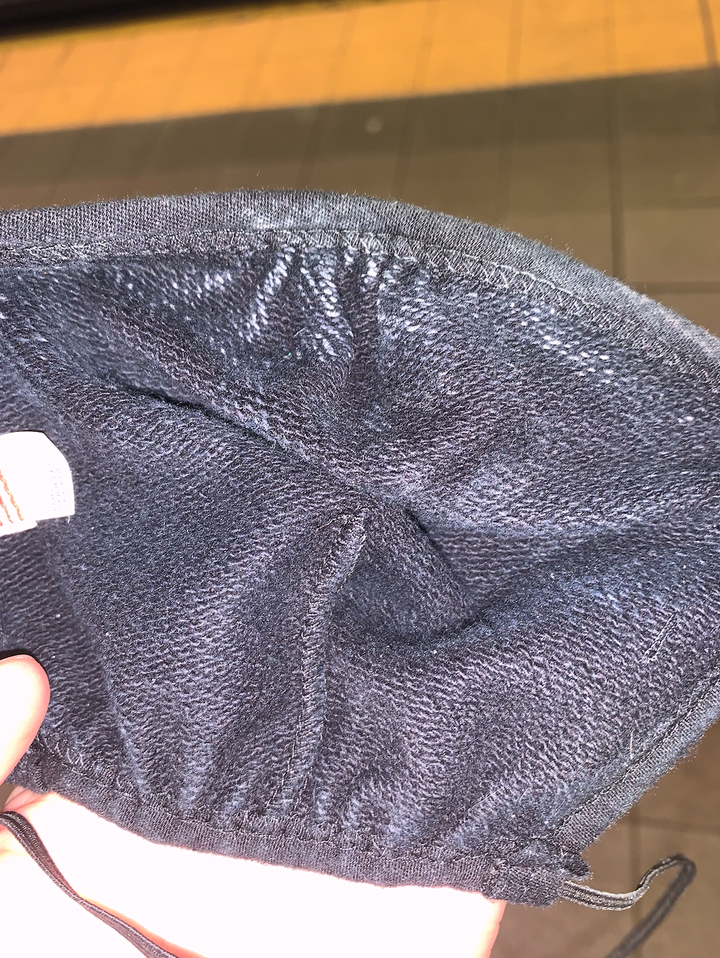
The Result: Winner!
Niko Maragos
This was, all around, the most effective technique. There was absolutely still transfer on my nose, but even that was less than with the other techniques, which is especially impressive. While testing this technique, I had my longest mean solar day of protesting yet, in terms of both time spent and miles walked. Given those weather and the simplicity of the technique, this is my top recommendation.
Only as a caveat to that recommendation, consider that I've subjected all of these techniques to a particularly intense trial. For anyone who will be wearing a mask for a short corporeality of time ― say, to walk the domestic dog, take a trip to the store or even to find a place in the park for a socially-distanced mean solar day in the sun ― any one of these techniques will be sufficient.
Information technology'due south also important to go on in mind that makeup is ultimately a matter of eyes, not physics. There is only and so much yous can practice to limit transfer if you are removing your mask aggressively, or if information technology fits too tight on the face up.

Ear Savers For Confront Masks
Source: https://www.huffpost.com/entry/face-mask-makeup-foundation-wont-rub-off_l_5ee7b3afc5b69e598c702b43
Posted by: ramosinion1939.blogspot.com
0 Response to "How To Apply Makeup So That It Doesnt Look Like You Have It On"
Post a Comment