

What Is The Chemical Makeup Of A Rock
| Sedimentary rock | |
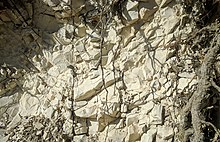
 Limestone outcrop in the Torcal de Antequera nature reserve of Málaga, Spain | |
| Composition | |
|---|---|
| Calcium carbonate: inorganic crystalline calcite or organic calcareous material |
Limestone is a common type of carbonate sedimentary rock. It is equanimous mostly of the minerals calcite and aragonite, which are different crystal forms of calcium carbonate (CaCO3 ). Limestone forms when these minerals precipitate out of water containing dissolved calcium. This can take place through both biological and nonbiological processes, though biological processes, such as the aggregating of corals and shells in the sea, have likely been more important for the last 540 million years.[1] [ii] Limestone often contains fossils, and these provide scientists with data on ancient environments and on the evolution of life.[3]
About twenty% to 25% of sedimentary rock is carbonate stone, and most of this is limestone.[four] [iii] The remaining carbonate stone is more often than not dolomite, a closely related rock, which contains a high percentage of the mineral dolomite, CaMg(COthree)ii . Magnesian limestone is an obsolete and poorly-defined term used variously for dolomite, for limestone containing significant dolomite (dolomitic limestone), or for any other limestone containing a significant percentage of magnesium.[5] About limestone was formed in shallow marine environments, such as continental shelves or platforms, though smaller amounts were formed in many other environments. Much dolomite is secondary dolomite, formed by chemical amending of limestone.[6] [vii] Limestone is exposed over big regions of the Globe's surface, and considering limestone is slightly soluble in rainwater, these exposures often are eroded to become karst landscapes. Most cavern systems are establish in limestone boulder.
Limestone has numerous uses: equally a edifice material, an essential component of concrete (Portland cement), as aggregate for the base of roads, every bit white pigment or filler in products such as toothpaste or paints, as a chemic feedstock for the production of lime, as a soil conditioner, and as a popular decorative add-on to rock gardens. Limestone formations incorporate well-nigh thirty% of the world's petroleum reservoirs.[3]
Description [edit]
Limestone is composed mostly of the minerals calcite and aragonite, which are unlike crystal forms of calcium carbonate (CaCO3 ). Dolomite, CaMg(CO3)2 , is an uncommon mineral in limestone, and siderite or other carbonate minerals are rare. However, the calcite in limestone oft contains a few percent of magnesium. Calcite in limestone is divided into low-magnesium and high-magnesium calcite, with the dividing line placed at a composition of 4% magnesium. High-magnesium calcite retains the calcite mineral structure, which is distinct from dolomite. Aragonite does not usually contain significant magnesium.[8] Most limestone is otherwise chemically adequately pure, with clastic sediments (mainly fine-grained quartz and dirt minerals) making up less than 5%[9] to 10%[10] of the composition. Organic matter typically makes up around 0.ii% of a limestone and rarely exceeds one%.[eleven]
Limestone often contains variable amounts of silica in the class of chert or siliceous skeletal fragments (such as sponge spicules, diatoms, or radiolarians).[12] Fossils are also common in limestone.[3]
Limestone is usually white to gray in color. Limestone that is unusually rich in organic matter tin can be almost black in colour, while traces of iron or manganese tin can give limestone an off-white to yellow to red color. The density of limestone depends on its porosity, which varies from 0.1% for the densest limestone to 40% for chalk. The density correspondingly ranges from 1.v to 2.seven g/cm3. Although relatively soft, with a Mohs hardness of 2 to 4, dense limestone can accept a crushing forcefulness of up to 180 MPa.[13] For comparing, concrete typically has a crushing forcefulness of about forty MPa.[14]
Although limestones show little variability in mineral composition, they bear witness neat diverseness in texture.[15] Nonetheless, near limestone consists of sand-sized grains in a carbonate mud matrix. Considering limestones are often of biological origin and are usually composed of sediment that is deposited close to where it formed, classification of limestone is commonly based on its grain type and mud content.[9]
Grains [edit]
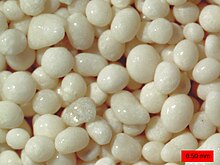
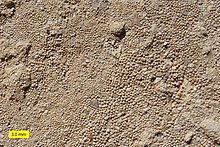
Ooids in limestone of the Carmel Formation (Middle Jurassic) of southwestern Utah.
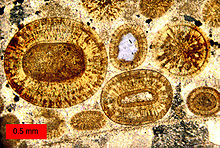
Thin-department view of a Middle Jurassic limestone in southern Utah, U.Due south. The round grains are ooids; the largest is 1.2 mm (0.05 in) in diameter. This limestone is an oosparite.
Nigh grains in limestone are skeletal fragments of marine organisms such every bit coral or foraminifera.[16] These organisms secrete structures made of aragonite or calcite, and leave these structures backside when they die. Other carbonate grains composing limestones are ooids, peloids, and limeclasts (intraclasts and extraclasts).[17]
Skeletal grains have a limerick reflecting the organisms that produced them and the environment in which they were produced.[18] Low-magnesium calcite skeletal grains are typical of articulate brachiopods, planktonic (free-floating) foraminifera, and coccoliths. Loftier-magnesium calcite skeletal grains are typical of benthic (bottom-dwelling) foraminifera, echinoderms, and coralline algae. Aragonite skeletal grains are typical of molluscs, calcareous green algae, stromatoporoids, corals, and tube worms. The skeletal grains also reflect specific geological periods and environments. For example, coral grains are more common in high-energy environments (characterized by potent currents and turbulence) while bryozoan grains are more mutual in low-energy environments (characterized past quiet water).[19]
Ooids (sometimes called ooliths) are sand-sized grains (less than 2mm in diameter) consisting of one or more layers of calcite or aragonite around a central quartz grain or carbonate mineral fragment. These likely form past direct precipitation of calcium carbonate onto the ooid. Pisoliths are similar to ooids, but they are larger than 2mm in diameter and tend to be more irregular in shape. Limestone equanimous more often than not of ooids is called an oolite or sometimes an oolitic limestone. Ooids form in loftier-energy environments, such equally the Bahama platform, and oolites typically bear witness crossbedding and other features associated with deposition in strong currents.[xx] [21]
Oncoliths resemble ooids but show a radial rather than layered internal structure, indicating that they were formed by algae in a normal marine surround.[20]
Peloids are structureless grains of microcrystalline carbonate likely produced by a variety of processes.[22] Many are thought to be fecal pellets produced by marine organisms. Others may exist produced by endolithic (deadening) algae[23] or other microorganisms[24] or through breakup of mollusc shells.[25] They are hard to see in a limestone sample except in thin section and are less common in ancient limestones, perchance considering compaction of carbonate sediments disrupts them.[23]
Limeclasts are fragments of existing limestone or partially lithified carbonate sediments. Intraclasts are limeclasts that originate close to where they are deposited in limestone, while extraclasts come from outside the depositional area. Intraclasts include grapestone, which is clusters of peloids cemented together past organic material or mineral cement. Extraclasts are uncommon, are usually accompanied by other clastic sediments, and indicate deposition in a tectonically agile area or equally part of a turbidity current.[26]
Mud [edit]
The grains of most limestones are embedded in a matrix of carbonate mud. This is typically the largest fraction of an ancient carbonate rock.[23] Mud consisting of individual crystals less than 5 microns in length is described as micrite.[27] In fresh carbonate mud, micrite is generally pocket-size aragonite needles, which may precipitate directly from seawater,[28] be secreted by algae,[29] or be produced by abrasion of carbonate grains in a loftier-energy environment.[30] This is converted to calcite within a few million years of deposition. Farther recrystallization of micrite produces microspar, with grains from five to fifteen microns in bore.[28]
Limestone often contains larger crystals of calcite, ranging in size from 0.02 to 0.1 mm, that are described as sparry calcite or sparite. Sparite is distinguished from micrite by a grain size of over 20 microns and considering sparite stands out under a hand lens or in thin section as white or transparent crystals. Sparite is distinguished from carbonate grains by its lack of internal structure and its characteristic crystal shapes. [31]
Geologists are careful to distinguish between sparite deposited as cement and sparite formed by recrystallization of micrite or carbonate grains. Sparite cement was probable deposited in pore space between grains, suggesting a high-energy depositional environs that removed carbonate mud. Recrystallized sparite is not diagnostic of depositional environs.[31]
Other characteristics [edit]

Limestone outcrops are recognized in the field by their softness (calcite and aragonite both have a Mohs hardness of less than 4, well below common silicate minerals) and because limestone bubbles vigorously when a driblet of dilute muriatic acid is dropped on it. Dolomite is also soft but reacts simply feebly with dilute hydrochloric acrid, and it commonly weathers to a characteristic boring yellowish-brown color due to the presence of ferrous fe. This is released and oxidized as the dolomite weathers.[9] Impurities (such every bit clay, sand, organic remains, iron oxide, and other materials) will cause limestones to exhibit different colors, particularly with weathered surfaces.
The makeup of a carbonate rock outcrop can be estimated in the field by etching the surface with dilute hydrochloric acid. This etches away the calcite and aragonite, leaving behind any silica or dolomite grains. The latter can be identified by their rhombohedral shape.[9]
Crystals of calcite, quartz, dolomite or barite may line pocket-sized cavities (vugs) in the rock. Vugs are a form of secondary porosity, formed in existing limestone by a alter in environment that increases the solubility of calcite.[32]
Dense, massive limestone is sometimes described as "marble". For example, the famous Portoro "marble" of Italia is really a dumbo black limestone.[33] True marble is produced by recrystallization of limestone during regional metamorphism that accompanies the mountain building process (orogeny). Information technology is distinguished from dense limestone past its fibroid crystalline texture and the formation of distinctive minerals from the silica and clay present in the original limestone.[34]
Nomenclature [edit]
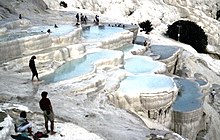
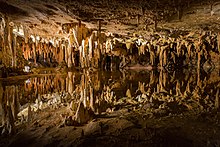
2 major classification schemes, the Folk and Dunham, are used for identifying the types of carbonate rocks collectively known as limestone.
Folk classification [edit]
Robert L. Folk adult a classification system that places primary emphasis on the detailed composition of grains and interstitial material in carbonate rocks.[35] Based on limerick, at that place are iii main components: allochems (grains), matrix (more often than not micrite), and cement (sparite). The Folk system uses two-role names; the starting time refers to the grains and the 2nd to the cement. For example, a limestone consisting mainly of ooids, with a crystalline matrix, would be termed an oosparite. It is helpful to have a petrographic microscope when using the Folk scheme, because information technology is easier to determine the components present in each sample.[36]
Dunham nomenclature [edit]
Robert J. Dunham published his organisation for limestone in 1962. It focuses on the depositional fabric of carbonate rocks. Dunham divides the rocks into 4 chief groups based on relative proportions of coarser clastic particles, based on criteria such as whether the grains were originally in common contact, and therefore self-supporting, or whether the stone is characterized by the presence of frame builders and algal mats. Unlike the Folk scheme, Dunham deals with the original porosity of the rock. The Dunham scheme is more useful for hand samples because it is based on texture, not the grains in the sample.[37]
A revised classification was proposed by Wright (1992). It adds some diagenetic patterns to the classification scheme.[38]
Other descriptive terms [edit]
Travertine is a term applied to calcium carbonate deposits formed in freshwater environments, specially hot springs. Such deposits are typically massive, dumbo, and banded. When the deposits are highly porous, and so that they accept a spongelike texture, they are typically described equally tufa. Secondary calcite deposited by supersaturated meteoric waters (groundwater) in caves is as well sometimes described as travertine. This produces speleothems, such as stalagmites and stalactites.[39]
Coquina is a poorly consolidated limestone equanimous of abraded pieces of coral, shells, or other fossil droppings. When ameliorate consolidated, information technology is described equally coquinite.[xl]
Chalk is a soft, earthy, fine-textured limestone composed of the tests of planktonic microorganisms such as foraminifera, while marl is an earthy mixture of carbonates and silicate sediments.[forty]
Formation [edit]
Limestone forms when calcite or aragonite precipitate out of water containing dissolved calcium, which can accept place through both biological and nonbiological processes.[41] The solubility of calcium carbonate (CaCO3 ) is controlled largely by the amount of dissolved carbon dioxide (CO2 ) in the h2o. This is summarized in the reaction:
-
- CaCO3 + H2O + CO2 → Ca2+ + 2HCO − 3
Increases in temperature or decreases in force per unit area tend to reduce the amount of dissolved CO2 and precipitate CaCOthree . Reduction in salinity also reduces the solubility of CaCO3 , by several orders of magnitude for fresh h2o versus seawater. [42]
Near-surface h2o of the earth's oceans are oversaturated with CaCOthree past a factor of more than than six.[43] The failure of CaCO3 to rapidly precipitate out of these waters is likely due to interference by dissolved magnesium ions with nucleation of calcite crystals, the necessary first step in precipitation. Precipitation of aragonite may be suppressed by the presence of naturally occurring organic phosphates in the water. Although ooids probable course through purely inorganic processes, the bulk of CaCOiii atmospheric precipitation in the oceans is the result of biological activeness.[44] Much of this takes place on carbonate platforms.
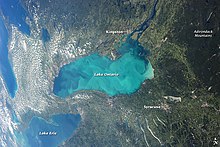
An aerial view of a whiting issue atmospheric precipitation deject in Lake Ontario.
The origin of carbonate mud,[thirty] and the processes by which it is converted to micrite,[45] continue to be a bailiwick of research. Modern carbonate mud is composed mostly of aragonite needles effectually five microns in length. Needles of this shape and composition are produced by calcareous algae such equally Penicillus, making this a plausible source of mud.[46] Another possibility is straight precipitation from the water. A miracle known as whitings occurs in shallow waters, in which white streaks containing dispersed micrite announced on the surface of the water. It is uncertain whether this is freshly precipitated aragonite or merely material stirred up from the lesser, simply there is some evidence that whitings are acquired by biological precipitation of aragonite as role of a bloom of cyanobacteria or microalgae.[47] All the same, stable isotope ratios in modern carbonate mud announced to be inconsistent with either of these mechanisms, and abrasion of carbonate grains in high-free energy environments has been put forward as a tertiary possibility.[30]
Formation of limestone has likely been dominated by biological processes throughout the Phanerozoic, the concluding 540 meg years of the World's history. Limestone may have been deposited by microorganisms in the Precambrian, prior to 540 million years agone, but inorganic processes were probably more important and likely took identify in an ocean more highly oversaturated in calcium carbonate than the mod sea.[48]
Diagenesis [edit]
Diagenesis is the process in which sediments are compacted and turned into solid stone. During diagenesis of carbonate sediments, significant chemical and textural changes accept place. For example, aragonite is converted to low-magnesium calcite. Diagenesis is the likely origin of pisoliths, concentrically layered particles ranging from i to 10 millimeters (0.039 to 0.394 in) in diameter plant in some limestones. Pisoliths superficially resemble ooids only have no nucleus of foreign matter, fit together tightly, and prove other signs that they formed after the original deposition of the sediments.[49]

Akcakoca chert nodules within soft limestone
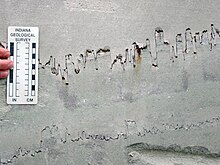
Silicification occurs early in diagenesis, at low pH and temperature, and contributes to fossil preservation. Silicification takes place through the reaction:
-
- CaCO3 + H2O + COii + HivSiOiv → SiOii + Caii+ + 2HCO − iii + 2 H2O
Fossils are often preserved in exquisite particular as chert.[50]
Cementing takes place rapidly in carbonate sediments, typically within less than a million years of degradation. Some cementing occurs while the sediments are still under water, forming hardgrounds. Cementing accelerates after the retreat of the sea from the depositional environment, equally rainwater infiltrates the sediment beds, oftentimes inside simply a few thousand years. As rainwater mixes with groundwater, aragonite and high-magnesium calcite are converted to low-calcium calcite. Cementing of thick carbonate deposits by rainwater may embark even before the retreat of the bounding main, equally rainwater can infiltrate over 100 kilometers (sixty mi) into sediments beneath the continental shelf.[51]
As carbonate sediments are increasingly deeply buried under younger sediments, chemical and mechanical compaction of the sediments increases. Chemical compaction takes place past force per unit area solution of the sediments. This process dissolves minerals from points of contact betwixt grains and redeposits it in pore space, reducing the porosity of the limestone from an initial loftier value of twoscore% to 80% to less than 10%.[52] Pressure solution produces distinctive styolites, irregular surfaces within the limestone at which silica-rich sediments accrue. These may reflect dissolution and loss of a considerable fraction of the limestone bed. At depths greater than 1 kilometer (0.62 mi), burying cementation completes the lithification procedure. Burial cementation does not produce styolites.[53]
When overlying beds are eroded, bringing limestone closer to the surface, the last stage of diagenesis takes place. This produces secondary porosity as some of the cement is dissolved by rainwater infiltrating the beds. This may include the formation of vugs, which are crystal-lined cavities within the limestone.[53]
Diagenesis may include conversion of limestone to dolomite by magnesium-rich fluids. There is considerable show of replacement of limestone by dolomite, including precipitous replacement boundaries that cut across bedding.[54] The process of dolomitization remains an area of agile enquiry,[55] simply possible mechanisms include exposure to concentrated brines in hot environments (evaporative reflux) or exposure to diluted seawater in delta or estuary environments (Dorag dolomitization).[56] However, Dorag dolomitization has fallen into disfavor as a machinery for dolomitization,[57] with one 2004 review paper describing it bluntly as "a myth".[55] Ordinary seawater is capable of converting calcite to dolomite, if the seawater is regularly flushed through the stone, as by the ebb and menses of tides (tidal pumping).[54] Once dolomitization begins, it proceeds rapidly, and so that there is very fiddling carbonate stone containing mixed calcite and dolomite. Carbonate rock tends to be either virtually all calcite/aragonite or well-nigh all dolomite.[56]
Occurrence [edit]
About 20% to 25% of sedimentary rock is carbonate rock,[3] and most of this is limestone.[17] [3] Limestone is found in sedimentary sequences every bit old as two.7 billion years.[58] However, the compositions of carbonate rocks testify an uneven distribution in fourth dimension in the geologic record. Virtually 95% of modern carbonates are equanimous of high-magnesium calcite and aragonite.[59] The aragonite needles in carbonate mud are converted to low-magnesium calcite within a few one thousand thousand years, equally this is the most stable form of calcium carbonate.[28] Ancient carbonate formations of the Precambrian and Paleozoic comprise arable dolomite, just limestone dominates the carbonate beds of the Mesozoic and Cenozoic. Modern dolomite is quite rare. There is evidence that, while the modern ocean favors precipitation of aragonite, the oceans of the Paleozoic and middle to late Cenozoic favored precipitation of calcite. This may bespeak a lower Mg/Ca ratio in the ocean h2o of those times.[60] This magnesium depletion may exist a result of more rapid bounding main floor spreading, which removes magnesium from bounding main water. The mod ocean and the ocean of the Mesozoic have been described equally "aragonite seas".[61]
Near limestone was formed in shallow marine environments, such as continental shelves or platforms. Such environments course only about 5% of the ocean basins, only limestone is rarely preserved in continental slope and deep body of water environments. The best environments for deposition are warm waters, which have both a high organic productivity and increased saturation of calcium carbonate due to lower concentrations of dissolved carbon dioxide. Modernistic limestone deposits are almost ever in areas with very little silica-rich sedimentation, reflected in the relative purity of about limestones. Reef organisms are destroyed by dingy, stagnant river h2o, and carbonate grains are ground down past much harder silicate grains.[62] Dissimilar clastic sedimentary rock, limestone is produced almost entirely from sediments originating at or about the place of deposition.[63]
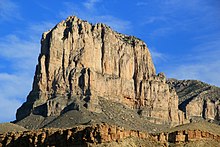
Limestone formations tend to bear witness abrupt changes in thickness. Large moundlike features in a limestone germination are interpreted equally aboriginal reefs, which when they announced in the geologic record are called bioherms. Many are rich in fossils, just about lack any continued organic framework like that seen in modern reefs. The fossil remains are present every bit carve up fragments embedded in ample mud matrix. Much of the sedimentation shows indications of occurring in the intertidal or supratidal zones, suggesting sediments rapidly fill up available accommodation space in the shelf or platform.[64] Degradation is likewise favored on the seaward margin of shelves and platforms, where there is upwelling deep sea water rich in nutrients that increase organic productivity. Reefs are common here, but when defective, ooid shoals are found instead. Finer sediments are deposited close to shore.[65]
The lack of deep ocean limestones is due in part to rapid subduction of oceanic crust, only is more a consequence of dissolution of calcium carbonate at depth. The solubility of calcium carbonate increases with pressure and fifty-fifty more with higher concentrations of carbon dioxide, which is produced by decomposable organic matter settling into the deep bounding main that is non removed by photosynthesis in the dark depths. As a result, at that place is a fairly sharp transition from water saturated with calcium carbonate to water unsaturated with calcium carbonate, the lysocline, which occurs at the calcite compensation depth of four,000 to vii,000 meters (xiii,000 to 23,000 ft). Beneath this depth, foraminifera tests and other skeletal particles rapidly deliquesce, and the sediments of the ocean floor abruptly transition from carbonate ooze rich in foraminifera and coccolith remains (Globigerina ooze) to silicic mud lacking carbonates.[66]

In rare cases, turbidites or other silica-rich sediments coffin and preserve benthic (deep body of water) carbonate deposits. Ancient benthic limestones are microcrystalline and are identified by their tectonic setting. Fossils typically are foraminifera and coccoliths. No pre-Jurassic benthic limestones are known, probably because carbonate-shelled plankton had not notwithstanding evolved.[67]
Limestones as well class in freshwater environments.[68] These limestones are not unlike marine limestone, but have a lower diversity of organisms and a greater fraction of silica and clay minerals characteristic of marls. The Greenish River Germination is an example of a prominent freshwater sedimentary formation containing numerous limestone beds.[69] Freshwater limestone is typically micritic. Fossils of charophyte (stonewort), a form of freshwater light-green algae, are feature of these environments, where the charophytes produce and trap carbonates.[lxx]
Limestones may also form in evaporite depositional environments.[71] [72] Calcite is one of the first minerals to precipitate in marine evaporites.[73]
Limestone and living organisms [edit]
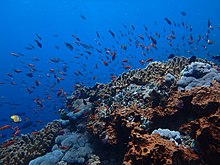
Most limestone is formed past the activities of living organisms near reefs, but the organisms responsible for reef formation have changed over geologic time. For example, stromatolites are mound-shaped structures in ancient limestones, interpreted as colonies of cyanobacteria that accumulated carbonate sediments, just stromatolites are rare in younger limestones.[74] Organisms precipitate limestone both directly as part of their skeletons, and indirectly past removing carbon dioxide from the h2o by photosynthesis and thereby decreasing the solubility of calcium carbonate.[70]
Limestone shows the same range of sedimentary structures found in other sedimentary rocks. Even so, finer structures, such every bit lamination, are often destroyed past the burrowing activities of organisms (bioturbation). Fine lamination is characteristic of limestone formed in playa lakes, which lack the burrowing organisms.[75] Limestones too show distinctive features such every bit geopetal structures, which class when curved shells settle to the bottom with the concave face downwards. This traps a void infinite that can later be filled past sparite. Geologists use geopetal structures to determine which direction was up at the time of deposition, which is not always obvious with highly deformed limestone formations.[76]
The cyanobacterium Hyella balani can diameter through limestone; every bit can the green alga Eugamantia sacculata and the fungus Ostracolaba implexa.[77]
Micritic mud mounds [edit]
Micricitic mud mounds are subcircular domes of micritic calcite that lacks internal structure. Modern examples are up to several hundred meters thick and a kilometer beyond, and have steep slopes (with slope angles of around 50 degrees). They may be composed of peloids swept together by currents and stabilized by Thallasia grass or mangroves. Bryozoa may also contribute to mound germination by helping to trap sediments.[78]
Mud mounds are plant throughout the geologic record, and prior to the early on Ordovician, they were the ascendant reef type in both deep and shallow water. These mud mounds probable are microbial in origin. Post-obit the advent of frame-edifice reef organisms, mud mounds were restricted mainly to deeper water.[79]
Organic reefs [edit]
Organic reefs form at low latitudes in shallow water, not more than a few meters deep. They are complex, various structures found throughout the fossil record. The frame-building organisms responsible for organic reef formation are characteristic of different geologic time periods: Archaeocyathids appeared in the early Cambrian; these gave mode to sponges by the late Cambrian; later successions included stromatoporoids, corals, algae, bryozoa, and rudists (a form of bivalve mollusc).[fourscore] [81] [82] The extent of organic reefs has varied over geologic time, and they were likely most extensive in the centre Devonian, when they covered an area estimated at 5,000,000 foursquare kilometers (i,900,000 sq mi). This is roughly ten times the extent of modern reefs. The Devonian reefs were constructed largely by stromatoporoids and tabulate corals, which were devastated by the late Devonian extinction.[83]
Organic reefs typically have a circuitous internal construction. Whole body fossils are usually arable, but ooids and interclasts are rare within the reef. The core of a reef is typically massive and unbedded, and is surrounded by a talus that is greater in volume than the core. The talus contains abundant intraclasts and is unremarkably either floatstone, with ten% or more of grains over 2mm in size embedded in abundant matrix, or rudstone, which is mostly large grains with sparse matrix. The talus grades to planktonic fine-grained carbonate mud, then noncarbonate mud away from the reef.[80]
Limestone landscape [edit]
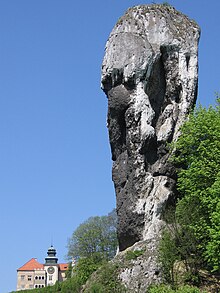
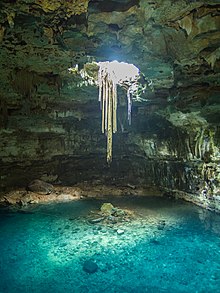

Limestone is partially soluble, especially in acid, and therefore forms many erosional landforms. These include limestone pavements, pot holes, cenotes, caves and gorges. Such erosion landscapes are known every bit karsts. Limestone is less resistant to erosion than most igneous rocks, but more resistant than virtually other sedimentary rocks. It is therefore usually associated with hills and downland, and occurs in regions with other sedimentary rocks, typically clays.[84] [85]
Karst regions overlying limestone bedrock tend to have fewer visible above-footing sources (ponds and streams), equally surface h2o easily drains downward through joints in the limestone. While draining, water and organic acid from the soil slowly (over thousands or millions of years) enlarges these cracks, dissolving the calcium carbonate and conveying it away in solution. Well-nigh cave systems are through limestone bedrock. Cooling groundwater or mixing of dissimilar groundwaters will likewise create weather condition suitable for cavern germination.[84]
Littoral limestones are ofttimes eroded by organisms which bore into the stone by various means. This process is known as bioerosion. Information technology is almost common in the tropics, and it is known throughout the fossil record.[86]
Bands of limestone emerge from the Globe'south surface in frequently spectacular rocky outcrops and islands. Examples include the Stone of Gibraltar,[87] the Burren in County Clare, Ireland;[88] Malham Cove in Northward Yorkshire and the Isle of Wight,[89] England; the Peachy Orme in Wales;[90] on Fårö nigh the Swedish island of Gotland,[91] the Niagara Escarpment in Canada/U.s.;[92] Notch Acme in Utah;[93] the Ha Long Bay National Park in Vietnam;[94] and the hills around the Lijiang River and Guilin city in Mainland china.[95]
The Florida Keys, islands off the due south declension of Florida, are equanimous mainly of oolitic limestone (the Lower Keys) and the carbonate skeletons of coral reefs (the Upper Keys), which thrived in the surface area during interglacial periods when sea level was higher than at nowadays.[96]
Unique habitats are constitute on alvars, extremely level expanses of limestone with thin soil mantles. The largest such expanse in Europe is the Stora Alvaret on the island of Öland, Sweden.[97] Some other area with big quantities of limestone is the island of Gotland, Sweden.[98] Huge quarries in northwestern Europe, such as those of Mountain Saint Peter (Kingdom of belgium/Netherlands), extend for more a hundred kilometers.[99]
Uses [edit]
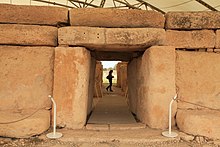

Limestone is a raw material that is used globally in a diverseness of different ways including construction, agronomics and as industrial materials.[101] Limestone is very mutual in architecture, particularly in Europe and N America. Many landmarks across the world, including the Great Pyramid and its associated complex in Giza, Egypt, were made of limestone. So many buildings in Kingston, Ontario, Canada were, and continue to exist, constructed from it that it is nicknamed the 'Limestone City'.[102] Limestone, metamorphosed past heat and pressure produces marble, which has been used for many statues, buildings and stone tabletops.[103] On the island of Malta, a diversity of limestone chosen Globigerina limestone was, for a long time, the only building cloth available, and is still very frequently used on all types of buildings and sculptures.[104]
Limestone can be processed into many various forms such equally brick, cement, powdered/crushed, or as a filler.[105] Limestone is readily bachelor and relatively easy to cut into blocks or more than elaborate carving.[100] Ancient American sculptors valued limestone because it was like shooting fish in a barrel to piece of work and expert for fine detail. Going dorsum to the Late Preclassic period (by 200–100 BCE), the Maya culture (Ancient United mexican states) created refined sculpture using limestone because of these excellent carving properties. The Maya would decorate the ceilings of their sacred buildings (known as lintels) and cover the walls with carved limestone panels. Carved on these sculptures were political and social stories, and this helped communicate letters of the king to his people.[106] Limestone is long-lasting and stands up well to exposure, which explains why many limestone ruins survive. However, it is very heavy (density two.6[107]), making it impractical for alpine buildings, and relatively expensive as a building cloth.
Limestone was nigh popular in the tardily 19th and early 20th centuries. Train stations, banks and other structures from that era were usually fabricated of limestone. It is used as a facade on some skyscrapers, but only in thin plates for roofing, rather than solid blocks. In the U.s.a., Indiana, most notably the Bloomington area, has long been a source of high-quality quarried limestone, chosen Indiana limestone. Many famous buildings in London are built from Portland limestone. Houses built in Odessa in Ukraine in the 19th century were mostly synthetic from limestone and the extensive remains of the mines now course the Odessa Catacombs.[108]
Limestone was as well a very popular building block in the Middle Ages in the areas where it occurred, since it is hard, durable, and commonly occurs in hands accessible surface exposures. Many medieval churches and castles in Europe are made of limestone. Beer rock was a pop kind of limestone for medieval buildings in southern England.[109]
-
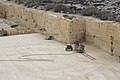
Cutting limestone blocks at a quarry in Gozo, Malta
-

Limestone as building material
-

Limestone is used worldwide as edifice material.
Limestone is the raw fabric for production of lime, primarily known for treating soils, purifying water and smelting copper. Lime is an important ingredient used in chemic industries.[110] Limestone and (to a lesser extent) marble are reactive to acid solutions, making acrid rain a significant problem to the preservation of artifacts fabricated from this stone. Many limestone statues and building surfaces have suffered severe damage due to acrid rain.[111] [112] Likewise limestone gravel has been used to protect lakes vulnerable to acid rain, interim as a pH buffering amanuensis.[113] Acrid-based cleaning chemicals can likewise compose limestone, which should but be cleaned with a neutral or mild brine-based cleaner.[114]
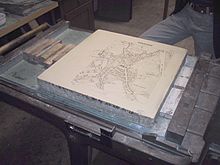
A limestone plate with a negative map of Moosburg in Bavaria is prepared for a lithography print.
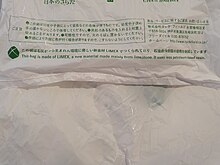
Plastic pocketbook "made mainly from limestone"
Other uses include:
- It is the raw material for the manufacture of quicklime (calcium oxide), slaked lime (calcium hydroxide), cement and mortar.[58]
- Pulverized limestone is used equally a soil conditioner to neutralize acidic soils (agricultural lime).[115]
- Is crushed for use as aggregate—the solid base for many roads equally well as in asphalt concrete.[58]
- Equally a reagent in flue-gas desulfurization, where information technology reacts with sulfur dioxide for air pollution command.[116]
- In glass making, peculiarly in the manufacture of soda-lime glass.[117]
- Equally an condiment toothpaste, paper, plastics, pigment, tiles, and other materials as both white pigment and a inexpensive filler.[118]
- As rock dust, to suppress marsh gas explosions in underground coal mines.[119]
- Purified, it is added to bread and cereals as a source of calcium.[120]
- As a calcium supplement in livestock feed, such equally for poultry (when ground up).[121]
- For remineralizing and increasing the alkalinity of purified h2o to prevent piping corrosion and to restore essential nutrient levels.[122]
- In blast furnaces, limestone binds with silica and other impurities to remove them from the iron.[123]
- Information technology can assistance in the removal of toxic components created from coal burning plants and layers of polluted molten metals.[124]
Many limestone formations are porous and permeable, which makes them of import petroleum reservoirs.[125] About twenty% of Due north American hydrocarbon reserves are found in carbonate rock. Carbonate reservoirs are very mutual in the petroleum-rich Centre East,[58] and carbonate reservoirs concur about a 3rd of all petroleum reserves worldwide.[126] Limestone formations are also common sources of metallic ores, because their porosity and permeability, together with their chemical activity, promotes ore deposition in the limestone. The pb-zinc deposits of Missouri and the Northwest Territories are examples of ore deposits hosted in limestone.[58]
Scarcity [edit]
Limestone is a major industrial raw textile that is in constant demand. This raw material has been essential in the atomic number 26 and steel manufacture since the nineteenth century.[127] Companies take never had a shortage of limestone; however, it has get a concern every bit the demand continues to increase[128] and it remains in high demand today.[129] The major potential threats to supply in the nineteenth century were regional availability and accessibility.[127] The ii main accessibility problems were transportation and property rights. Other problems were high uppercase costs on plants and facilities due to environmental regulations and the requirement of zoning and mining permits.[103] These two dominant factors led to the adaptation and option of other materials that were created and formed to blueprint alternatives for limestone that suited economical demands.[127]
Limestone was classified equally a critical raw material, and with the potential risk of shortages, information technology drove industries to find new culling materials and technological systems. This allowed limestone to no longer be classified as critical every bit replacement substances increased in product; minette ore is a common substitute, for example.[127]
Occupational safety and health [edit]
| NFPA 704 burn down diamond | |
|---|---|
| [130] 1 0 0 Limestone |

Powdered limestone as a food condiment is mostly recognized equally prophylactic[131] and limestone is not regarded as a chancy material. However, limestone dust tin be a mild respiratory and skin irritant, and dust that gets into the eyes can cause corneal abrasions. Because limestone contains modest amounts of silica, inhalation of limestone dust could potentially lead to silicosis or cancer.[130]
The states [edit]
The Occupational Condom and Health Administration (OSHA) has set the legal limit (permissible exposure limit) for limestone exposure in the workplace as 15 mg/m3 total exposure and 5 mg/m3 respiratory exposure over an 8-hour workday. The National Found for Occupational Safety and Wellness (NIOSH) has gear up a recommended exposure limit (REL) of x mg/miii total exposure and five mg/m3 respiratory exposure over an 8-hour workday.[132]
Graffiti [edit]
Removing graffiti from weathered limestone is difficult because it is a porous and permeable material. The surface is delicate so usual abrasion methods run the take a chance of severe surface loss. Considering it is an acid-sensitive rock some cleaning agents cannot be used due to adverse furnishings.[133]
Gallery [edit]
-
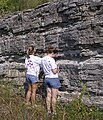
A stratigraphic section of Ordovician limestone exposed in central Tennessee, U.S. The less-resistant and thinner beds are composed of shale. The vertical lines are drill holes for explosives used during road construction.
-

-

Fossils in limestone from the northern Blackness Body of water region
-
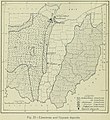
Limestone distribution in Ohio, from "Geography of Ohio," 1923
-

Chalk is a diverseness of limestone. It is a softer, and more powdery material.
Meet also [edit]
- Coral sand
- In Praise of Limestone – Poem past W. H. Auden
- Kurkar – Regional name for an aeolian quartz calcrete on the Levantine coast
- Limepit – Old method of calcining limestone
- Sandstone – Type of sedimentary rock
References [edit]
- ^ Boggs, Sam (2006). Principles of sedimentology and stratigraphy (fourth ed.). Upper Saddle River, N.J.: Pearson Prentice Hall. pp. 177, 181. ISBN0131547283.
- ^ Leong, Goh Cheng (27 October 1995). Certificate Physics And Human Geography; Indian Edition. Oxford University Printing. p. 62. ISBN978-0-19-562816-6.
- ^ a b c d e f Boggs 2006, p. 159.
- ^ Blatt, Harvey; Tracy, Robert J. (1996). Petrology : igneous, sedimentary, and metamorphic (2nd ed.). New York: W.H. Freeman. pp. 295–300. ISBN0716724383.
- ^ Jackson, Julia A., ed. (1997). "Magnesian limestone". Glossary of geology (Fourth ed.). Alexandria, Virginia: American Geological Institute. ISBN0922152349.
- ^ Blatt, Harvey; Middleton, Gerard; Murray, Raymond (1980). Origin of sedimentary rocks (2d ed.). Englewood Cliffs, N.J.: Prentice-Hall. pp. 446, 510–531. ISBN0136427103.
- ^ Boggs 2006, p. 182-194.
- ^ Blatt, Middleton & Murray 1980, p. 448-449.
- ^ a b c d Blatt & Tracy 1996, p. 295.
- ^ Boggs 2006, p. 160.
- ^ Blatt, Middleton & Murray 1980, p. 467.
- ^ Blatt & Tracy 1996, pp. 301–302.
- ^ Oates, Tony (17 September 2010). "Lime and Limestone". Kirk-Othmer Encyclopedia of Chemical Technology: 1209130507212019.a01.pub3. doi:10.1002/0471238961.1209130507212019.a01.pub3. ISBN978-0471238966.
- ^ The Editors of Encyclopaedia Britannica. "Compressive strength test". Encyclopedia Britannica . Retrieved iv Feb 2021.
- ^ Blatt & Tracy 1996, pp. 295–296.
- ^ Blatt, Middleton & Murray 1980, p. 452.
- ^ a b Blatt & Tracy 1996, pp. 295–300.
- ^ Blatt, Middleton & Murray 1980, p. 449.
- ^ Boggs 2006, p. 161-164.
- ^ a b Blatt et al. sfn error: no target: CITEREFBlattTracy1996297-299 (help)
- ^ Boggs 2006, pp. 164–165.
- ^ Adachi, Natsuko; Ezaki, Yoichi; Liu, Jianbo (Feb 2004). "The fabrics and origins of peloids immediately after the stop-Permian extinction, Guizhou Province, South China". Sedimentary Geology. 164 (i–two): 161–178. Bibcode:2004SedG..164..161A. doi:10.1016/j.sedgeo.2003.10.007.
- ^ a b c Blatt & Tracy 1996, p. 298.
- ^ Chafetz, Henry Due south. (1986). "Marine Peloids: A Product of Bacterially Induced Atmospheric precipitation of Calcite". SEPM Journal of Sedimentary Enquiry. 56 (6): 812–817. doi:10.1306/212F8A58-2B24-11D7-8648000102C1865D.
- ^ Samankassou, Elias; Tresch, Jonas; Strasser, André (26 November 2005). "Origin of peloids in Early Cretaceous deposits, Dorset, South England" (PDF). Facies. 51 (1–4): 264–274. doi:10.1007/s10347-005-0002-8. S2CID 128851366.
- ^ Blatt & Tracy 1996, p. 299-300, 304.
- ^ Blatt, Middleton & Murray 1980, p. 460.
- ^ a b c Blatt & Tracy 1996, p. 300.
- ^ Boggs 2006, p. 166.
- ^ a b c Trower, Elizabeth J.; Lamb, Michael P.; Fischer, Woodward Due west. (16 March 2019). "The Origin of Carbonate Mud". Geophysical Research Letters. 46 (v): 2696–2703. Bibcode:2019GeoRL..46.2696T. doi:10.1029/2018GL081620. S2CID 134970335.
- ^ a b Boggs 2006, pp. 166–167.
- ^ Blatt & Tracy 1996, pp. 315–317.
- ^ Fratini, Fabio; Pecchioni, Elena; Cantisani, Emma; Antonelli, Fabrizio; Giamello, Marco; Lezzerini, Marco; Canova, Roberta (December 2015). "Portoro, the blackness and gilt Italian "marble"". Rendiconti Lincei. 26 (four): 415–423. doi:10.1007/s12210-015-0420-7. S2CID 129625906.
- ^ Blatt & Tracy 1996, pp. 474.
- ^ "Carbonate Classification: SEPM STRATA".
- ^ Folk, R. L. (1974). Petrology of Sedimentary Rocks. Austin, Texas: Hemphill Publishing. ISBN0-914696-14-nine.
- ^ Dunham, R. J. (1962). "Classification of carbonate rocks according to depositional textures". In Ham, W. Due east. (ed.). Classification of Carbonate Rocks. American Association of Petroleum Geologists Memoirs. Vol. one. pp. 108–121.
- ^ Wright, V.P. (1992). "A revised Nomenclature of Limestones". Sedimentary Geology. 76 (iii–four): 177–185. Bibcode:1992SedG...76..177W. doi:x.1016/0037-0738(92)90082-3.
- ^ Blatt, Middleton & Murray 1980, p. 479-480.
- ^ a b Boggs 2006, p. 172.
- ^ Boggs 2006, p. 177.
- ^ Boggs 2006, pp. 174–176.
- ^ Morse, John W.; Mackenzie, F.T. (1990). Geochemistry of sedimentary carbonates. Amsterdam: Elsevier. p. 217. ISBN9780080869629.
- ^ Boggs 2006, pp. 176–182.
- ^ Jerry Lucia, F. (September 2017). "Observations on the origin of micrite crystals". Marine and Petroleum Geology. 86: 823–833. doi:10.1016/j.marpetgeo.2017.06.039.
- ^ Blatt, Middleton & Murray 1980, pp. 460–464.
- ^ Boggs 2006, p. 180.
- ^ Boggs 2006, pp. 177, 181.
- ^ Blatt, Middleton & Murray 1980, pp. 497–501.
- ^ Blatt, Middleton & Murray 1980, p. 497-503.
- ^ Blatt & Tracy 1996, p. 312.
- ^ Blatt, Middleton & Murray 1980, pp. 507–509.
- ^ a b Blatt & Tracy 1996, p. 312-316.
- ^ a b Boggs 2006, pp. 186–187.
- ^ a b Machel, Hans G. (2004). "Concepts and models of dolomitization: a critical reappraisal". Geological Society, London, Special Publications. 235 (1): 7–63. Bibcode:2004GSLSP.235....7M. doi:10.1144/GSL.SP.2004.235.01.02. S2CID 131159219.
- ^ a b Blatt, Middleton & Murray 1980, pp. 512–528.
- ^ Luczaj, John A. (November 2006). "Evidence against the Dorag (mixing-zone) model for dolomitization forth the Wisconsin arch ― A instance for hydrothermal diagenesis". AAPG Message. 90 (11): 1719–1738. doi:10.1306/01130605077.
- ^ a b c d eastward Blatt, Middleton & Murray 1980, p. 445.
- ^ Blatt, Middleton & Murray 1980, p. 448.
- ^ Boggs 2006, p. 159-161.
- ^ Boggs 2006, p. 176-177.
- ^ Blatt, Middleton & Murray 1980, p. 446, 733.
- ^ Blatt, Middleton & Murray 1980, p. 468-470.
- ^ Blatt, Middleton & Murray 1980, p. 446-447.
- ^ Blatt & Tracy 1996, p. 306-307.
- ^ Blatt, Middleton & Murray 1980, p. 474-479.
- ^ Blatt & Tracy 1996, p. 308-309.
- ^ Roeser, Patricia; Franz, Sven O.; Litt, Thomas (1 December 2016). "Aragonite and calcite preservation in sediments from Lake Iznik related to bottom lake oxygenation and h2o cavalcade depth". Sedimentology. 63 (7): 2253–2277. doi:10.1111/sed.12306. ISSN 1365-3091.
- ^ Blatt, Middleton & Murray 1980, p. 480-482.
- ^ a b Blatt & Tracy 1996, p. 309-310.
- ^ Trewin, North. H.; Davidson, R. G. (1999). "Lake-level changes, sedimentation and faunas in a Middle Devonian basin-margin fish bed". Periodical of the Geological Society. 156 (iii): 535–548. Bibcode:1999JGSoc.156..535T. doi:x.1144/gsjgs.156.iii.0535. S2CID 131241083.
- ^ "Term 'evaporite'". Oilfield Glossary. Archived from the original on 31 Jan 2012. Retrieved 25 November 2011.
- ^ Boggs 2006, p. 662.
- ^ Blatt, Middleton & Murray 1980, pp. 446, 471–474.
- ^ Blatt, Middleton & Murray 1980, pp. 446–471.
- ^ Blatt & Tracy 1996, p. 304.
- ^ Ehrlich, Henry Lutz; Newman, Dianne Thousand. (2009). Geomicrobiology (fifth ed.). pp. 181–182. ISBN9780849379079. Archived from the original on ten May 2016.
- ^ Blatt & Tracy 1996, p. 307.
- ^ Pratt, Brian R. (1995). "The origin, biota, and development of deep-water mud-mounds". Spec. Publs Int. Donkey. Sediment. 23: 49–123. ISBN9781444304121 . Retrieved iv February 2021.
- ^ a b Blatt & Tracy 1996, pp. 307–308.
- ^ Riding, Robert (July 2002). "Structure and limerick of organic reefs and carbonate mud mounds: concepts and categories". Earth-Science Reviews. 58 (one–ii): 163–231. Bibcode:2002ESRv...58..163R. doi:x.1016/S0012-8252(01)00089-7.
- ^ Woods, Rachel (1999). Reef evolution. Oxford: Oxford University Press. ISBN0198577842 . Retrieved 5 February 2021.
- ^ McGhee, George R. (2013). When the invasion of country failed : the legacy of the Devonian extinctions. New York: Columbia Academy Printing. p. 101. ISBN9780231160575.
- ^ a b Thornbury, William D. (1969). Principles of geomorphology (2nd ed.). New York: Wiley. pp. 303–344. ISBN0471861979.
- ^ "Karst Landscapes of Illinois: Dissolving Bedrock and Collapsing Soil". Prairie Inquiry Institute. Illinois State Geological Survey. Retrieved 26 Dec 2020.
- ^ Taylor, P. D.; Wilson, M. A. (2003). "Palaeoecology and development of marine hard substrate communities" (PDF). World-Science Reviews. 62 (ane–2): i–103. Bibcode:2003ESRv...62....1T. doi:x.1016/S0012-8252(02)00131-9. Archived from the original (PDF) on 25 March 2009.
- ^ Rodrı́guez-Vidal, J.; Cáceres, L.Yard.; Finlayson, J.C.; Gracia, F.J.; Martı́nez-Aguirre, A. (Oct 2004). "Neotectonics and shoreline history of the Stone of Gibraltar, southern Iberia". Quaternary Science Reviews. Elsevier (2004). 23 (18–xix): 2017–2029. Bibcode:2004QSRv...23.2017R. doi:10.1016/j.quascirev.2004.02.008. Retrieved 23 June 2016.
- ^ McNamara, M.; Hennessy, R. (2010). "The geology of the Burren region, Co. Clare, Ireland" (PDF). Project NEEDN, The Burren Connect Projection. Ennistymon: Clare County Council. Retrieved iii February 2021.
- ^ "Isle of Wight, Minerals" (PDF). Archived from the original (PDF) on 2 Nov 2006. Retrieved 8 October 2006.
- ^ Juerges, A.; Hollis, C. E.; Marshall, J.; Crowley, S. (May 2016). "The control of basin evolution on patterns of sedimentation and diagenesis: an example from the Mississippian Great Orme, Due north Wales". Periodical of the Geological Order. 173 (three): 438–456. Bibcode:2016JGSoc.173..438J. doi:10.1144/jgs2014-149.
- ^ Cruslock, Eva Thousand.; Naylor, Larissa A.; Foote, Yolanda Fifty.; Swantesson, Jan O.H. (Jan 2010). "Geomorphologic equifinality: A comparison between shore platforms in Höga Kusten and Fårö, Sweden and the Vale of Glamorgan, South Wales, UK". Geomorphology. 114 (one–2): 78–88. Bibcode:2010Geomo.114...78C. doi:ten.1016/j.geomorph.2009.02.019.
- ^ Luczaj, John A. (2013). "Geology of the Niagara Escarpment in Wisconsin". Geoscience Wisconsin. 22 (ane): 1–34. Retrieved v February 2021.
- ^ Miller, James F. (1969). "Conodont Fauna of the Notch Peak Limestone (Cambro-Ordovician), Business firm Range, Utah". Journal of Paleontology. 43 (2): 413–439. JSTOR 1302317.
- ^ Tran Duc Thanh; Waltham Tony (ane September 2001). "The outstanding value of the geology of Ha Long Bay". Advances in Natural Sciences. 2 (3). ISSN 0866-708X.
- ^ Waltham, Tony (2010). Migon, Piotr (ed.). Guangxi Karst: The Fenglin and Fengcong Karst of Guilin and Yangshuo, in Geomorphological Landscapes of the World. Springer. pp. 293–302. ISBN9789048130542.
- ^ Mitchell-Borer, Hugh J. (Leap 1980). "Depositional History of the Oolite of the Miami Limestone Formation". Florida Scientist. 43 (2): 116–125. JSTOR 24319647.
- ^ Thorsten Jansson, Stora Alvaret, Lenanders Tryckeri, Kalmar, 1999
- ^ Laufeld, S. (1974). Silurian Chitinozoa from Gotland. Fossils and Strata. Universitetsforlaget.
- ^ Pereira, Dolores; Tourneur, Francis; Bernáldez, Lorenzo; Blázquez, Ana García (2014). "Petit Granit: A Belgian limestone used in heritage, construction and sculpture" (PDF). Episodes. 38 (ii): thirty. Bibcode:2014EGUGA..16...30P. Retrieved v Feb 2021.
- ^ a b Cassar, Joann (2010). "The use of limestone in historic context". In Smith, Bernard J. (ed.). Limestone in the Built Environment: Present-day Challenges for the Preservation of the Past. Geographical Society of London. pp. xiii–23. ISBN9781862392946. Archived from the original on xv February 2017.
- ^ Oates, J. A. (north.d.). Lime and limestone. Retrieved February 23, 2021, from https://books.google.ca/books?id=MVoEMNI5Vb0C&printsec=frontcover&dq=limestone%2Buses&hl=en&sa=X&ved=2ahUKEwje2dHc2YDvAhWviK0KHSb7CGcQ6AEwAHoECAQQAg#v=onepage&q=limestone%20uses&f=false
- ^ "Welcome to the Limestone Metropolis". Archived from the original on 20 February 2008. Retrieved 13 Feb 2008.
- ^ a b Corathers, L.A. (15 Feb 2019). "Lime". Metals and minerals: The states Geological Survey Minerals Yearbook 2014, Volume i. Washington, DC: USGS (published 2018). p. 43.1. ISBN978-1-4113-4253-viii.
- ^ Cassar, Joann (2010). "The apply of limestone in a historic context – the feel of Malta". Geological Order, London, Special Publications. 331 (i): 13–25. Bibcode:2010GSLSP.331...13C. doi:10.1144/SP331.ii. S2CID 129082854.
- ^ Oates, J. A. (n.d.). Lime and limestone. Retrieved February 23, 2021, from https://books.google.ca/books?id=MVoEMNI5Vb0C&printsec=frontcover&dq=limestone%2Buses&hl=en&sa=Ten&ved=2ahUKEwje2dHc2YDvAhWviK0KHSb7CGcQ6AEwAHoECAQQAg#v=onepage&q=limestone%20uses&f=faux
- ^ Schele, Linda; Miller, Mary Ellen. The Claret of Kings: Dynasty and Ritual in Maya Art. Kimbell Art Museum. p. 41.
- ^ P. Five. Sharma (1997), Environmental and Engineering Geophysics, Cambridge University Press, p. 17, doi:10.1017/CBO9781139171168, ISBN9781139171168
- ^ "Odessa catacombs". Odessa travel guide. Retrieved 13 June 2020.
- ^ Ashurst, John; Dimes, Francis G. (1998). Conservation of building and decorative rock. Butterworth-Heinemann. p. 117. ISBN978-0-7506-3898-2.
- ^ Bliss, J. D., Hayes, T. Southward., & Orris, G. J. (2012, August). Limestone—A Crucial and Versatile Industrial Mineral Article. Retrieved Feb 23, 2021, from https://pubs.usgs.gov/fs/2008/3089/fs2008-3089.pdf
- ^ Reisener, A.; Stäckle, B.; Snethlage, R. (1995). "ICP on furnishings on materials". Water, Air, & Soil Pollution. 85 (iv): 2701–2706. Bibcode:1995WASP...85.2701R. doi:10.1007/BF01186242. S2CID 94721996.
- ^ "Approaches in modeling the touch of air pollution-induced cloth deposition" (PDF). Archived from the original (PDF) on 16 July 2011. Retrieved 18 November 2010.
- ^ Clayton, Janet L.; Dannaway, Eric South.; Menendez, Raymond; Rauch, Henry W.; Renton, John J.; Sherlock, Sean M.; Zurbuch, Peter E. (1998). "Application of Limestone to Restore Fish Communities in Acidified Streams". North American Journal of Fisheries Management. 18 (2): 347–360. doi:10.1577/1548-8675(1998)018<0347:AOLTRF>2.0.CO;two.
- ^ Hatch, Jonathan (eighteen April 2018). "How to clean limestone". How to Clean Things. Saint Paul Media, Inc. Retrieved 5 Feb 2021.
- ^ Oates, J. A. H. (11 July 2008). Lime and Limestone: Chemistry and Engineering science, Production and Uses. John Wiley & Sons. pp. 111–3. ISBN978-3-527-61201-7.
- ^ Gutiérrez Ortiz, F. J.; Vidal, F.; Ollero, P.; Salvador, 50.; Cortés, V.; Giménez, A. (February 2006). "Pilot-Plant Technical Assessment of Wet Flue Gas Desulfurization Using Limestone". Industrial & Engineering science Chemical science Enquiry. 45 (four): 1466–1477. doi:10.1021/ie051316o.
- ^ Kogel, Jessica Elzea (2006). Industrial Minerals & Rocks: Commodities, Markets, and Uses. SME. ISBN9780873352338. Archived from the original on 16 December 2017.
- ^ Huwald, Eberhard (2001). "Calcium carbonate - paint and filler". Calcium Carbonate: 160–170. doi:10.1007/978-three-0348-8245-3_7. ISBN978-iii-0348-9490-6.
- ^ Human, C.One thousand.; Teacoach, K.A. (2009). "How does limestone rock grit prevent coal dust explosions in coal mines?" (PDF). Mining Engineering: 61. Retrieved xxx Nov 2020.
- ^ "Why Fortified Flour?". Wessex Factory . Retrieved v February 2021.
- ^ "A Guide to Giving Your Layer Hens Enough Calcium". Poultry One. Archived from the original on three April 2009.
- ^ "Nutrient minerals in drinking-h2o and the potential health consequences of consumption of demineralized and remineralized and altered mineral content drinking-water: Consensus of the meeting". Earth Wellness Organization report. Archived from the original on 24 December 2007.
- ^ Tylecote, R. F. (1992). A history of metallurgy (second ed.). London: Found of Materials. ISBN978-0901462886.
- ^ Bliss, J. D., Hayes, T. South., & Orris, G. J. (2012, August). Limestone—A Crucial and Versatile Industrial Mineral Commodity. Retrieved Feb 23, 2021, from https://pubs.usgs.gov/fs/2008/3089/fs2008-3089.pdf
- ^ Archie, 1000.E. (1952). "Classification of Carbonate Reservoir Rocks and Petrophysical Considerations". AAPG Bulletin. 36. doi:10.1306/3D9343F7-16B1-11D7-8645000102C1865D.
- ^ Boggs 2006, p. p=159.
- ^ a b c d Haumann, S. (2020). "Critical and scarce: the remarkable career of limestone 1850–1914". European Review of History: Revue européenne d'histoire. 27 (3): 273–293. doi:10.1080/13507486.2020.1737651. S2CID 221052279.
- ^ Sparenberg, O.; Heymann, M. (2020). "Introduction: resource challenges and constructions of scarcity in the nineteenth and twentieth centuries". European Review of History: Revue européenne d'histoire. 27 (3): 243–252. doi:10.1080/13507486.2020.1737653. S2CID 221055042.
- ^ ResearchAndMarkets.com (nine June 2020). "Global Limestone Market Analysis and Forecasts 2020-2027 - Steady Growth Projected over the Adjacent Few Years - ResearchAndMarkets.com". Limestone - Global Market Trajectory & Analytics. businesswire.com. Retrieved 24 March 2021.
- ^ a b Lhoist Northward America. "Material Safety Data Sheet: Limestone" (PDF) . Retrieved 5 February 2021.
- ^ "CFR - Lawmaking of Federal Regulations Title 21". US Food & Drug Administration. Us Department of Wellness & Human Services. Retrieved 5 February 2021.
- ^ "Limestone". NIOSH Pocket Guide to Chemical Hazards. CDC. Archived from the original on 20 Nov 2015. Retrieved 19 Nov 2015.
- ^ Weaver, Martin E. (October 1995). "Removing Graffiti from Historic Masonry". National Park Service. Retrieved 5 February 2019.
Further reading [edit]
 | Wikimedia Commons has media related to Limestone. |
- Boynton, Robert S. (1980). Chemical science and Technology of Lime and Limestone. Wiley. ISBN0471027715.

What Is The Chemical Makeup Of A Rock,
Source: https://en.wikipedia.org/wiki/Limestone
Posted by: ramosinion1939.blogspot.com
0 Response to "What Is The Chemical Makeup Of A Rock"
Post a Comment